











How to Choose the led strobe lights manufacturer and supplier ?
- Why supplier selection matters for professional stage lighting
- Impact on performance: flicker, color and reliability
- Long-term costs: lifetime, maintenance and support
- Brand risk and project delivery
- Key technical criteria when evaluating LED strobe lights manufacturers
- Flicker-free performance and dimming behavior
- Color quality: CRI, CCT, and stepless color mixing
- Optics, beam control and mechanical design
- Supply chain, certifications and manufacturing capability
- Certifications and standards
- Factory scale, automation and R&D
- Quality control and traceability
- How to evaluate suppliers: practical checklist and comparison
- Supplier audit checklist (quick on-site or virtual audit)
- Comparative table: choosing between common supplier types
- Testing and sample evaluation
- Procurement terms, warranty and post-sale support
- Warranty coverage and spare parts
- Logistics, MOQ and lead time
- Service & training
- Common Questions (FAQs)
- Conclusion and next steps
Choosing the right manufacturer and supplier for led strobe lights determines whether your production will deliver reliable, flicker-free lighting for broadcast, theater, concerts and events. This guide helps buyers quickly assess technical criteria (flicker, CRI, dimming), factory capability (ISO, production area, output), quality control, and commercial terms — with practical checklists, a supplier comparison table, and authoritative references to standards and industry guidance to support decisions.
Why supplier selection matters for professional stage lighting
Impact on performance: flicker, color and reliability
LED strobe lights are used both for theatrical effects and in broadcast/studio contexts where flicker, color accuracy and consistent strobe timing are critical. Poor electronics design (PWM at wrong frequencies, insufficient driver filtering) can cause visible flicker or rolling bars on camera. For broadcast-safe strobes, manufacturers should demonstrate compliance with recommended modulation limits such as those described in the IEEE guideline for LED modulation: IEEE 1789-2015.
Long-term costs: lifetime, maintenance and support
LED fixtures reduce lamp replacement costs, but total cost of ownership depends on thermal management, driver quality, and spare-parts availability. Typical high-quality LED modules have L70 lifetimes of 50,000–100,000 hours under appropriate thermal conditions — verify manufacturer test reports and mean time between failures (MTBF) data.
Brand risk and project delivery
A reliable manufacturer supports on-time delivery, customization, and after-sales service (warranty, repairs, firmware updates). Suppliers who can provide free lighting layout design, rapid prototyping and lifetime maintenance reduce project risk and timeline uncertainty.
Key technical criteria when evaluating LED strobe lights manufacturers
Flicker-free performance and dimming behavior
Ask for oscilloscope traces of output modulation, camera test footage (100/120 fps slow motion), and details on dimming method (PWM frequency, current regulation). For camera work, manufacturers should demonstrate flicker-free operation across the full dimming range and under camera shutter speeds used in production. Refer to modulation guidance from IEEE 1789 for acceptable flicker risk levels: IEEE 1789-2015.
Color quality: CRI, CCT, and stepless color mixing
High-CRI LED engines (CRI 90+) are essential for broadcast and theater to reproduce skin tones and costume colors accurately. For fixtures offering color temperature control or RGB/CMY mixing, ask for spectral power distribution (SPD) data and Delta-E metrics. Manufacturers with stepless color mixing and precise CCT control provide smoother on-camera transitions.
Optics, beam control and mechanical design
Confirm beam angle options, beam uniformity, and whether the fixture supports accessories (gobos, lenses, barn doors). Durable mechanical design (high-strength housings, reliable yokes) and IP ratings for touring rigs are important for outdoor or wet-environment applications.
Supply chain, certifications and manufacturing capability
Certifications and standards
Key certifications to verify:
- ISO (e.g., ISO 9001) — shows quality management systems; see ISO 9001.
- CE marking and RoHS compliance for EU markets — see European Commission guidance: CE, RoHS.
- Electrical safety and EMC testing (IEC/EN standards) — request test reports from accredited labs.
Manufacturers should be able to provide genuine certificates and corresponding test reports from third-party labs.
Factory scale, automation and R&D
Production capability directly affects lead times and customization. Large facilities with automated assembly and on-site R&D can prototype faster and support OEM/ODM projects. For example, Guangzhou LEEMC Stage Lighting Technology Co., Ltd. operates a 15,000㎡ high-tech facility with 200+ professionals and automated assembly lines, producing over 30,000 fixtures annually — strong indicators of volume capability and development bandwidth.
Quality control and traceability
Ask about incoming materials inspection, in-process testing, burn-in protocols (e.g., 48–72 hours at elevated temperature), and final acceptance tests (photometric reports, color consistency). Traceable batch numbers for LED engines and drivers simplify warranty work.
How to evaluate suppliers: practical checklist and comparison
Supplier audit checklist (quick on-site or virtual audit)
- Verify company registration, factory footprint and staffing.
- Request product samples and full technical datasheets (photometric diagrams, SPD, CRI reports).
- Review certifications and third-party lab test reports.
- Test a prototype under expected operating conditions (temperature, runtime, camera tests).
- Confirm warranty terms, spare-parts policy, and logistic capabilities (lead times, drop-shipping).
Comparative table: choosing between common supplier types
| Criteria | Large Certified Manufacturer | Small Workshop | Trading Company / Distributor |
|---|---|---|---|
| Certifications | ISO, CE, RoHS, third-party test reports | Often limited, may lack formal certifications | Depends on suppliers they represent |
| Production Capacity | High (tens of thousands/year) | Low to medium | Variable |
| Customization (OEM/ODM) | Strong — R&D & prototyping | Limited | Relies on partner factories |
| Quality Control | Stringent, automated tests | Inconsistent | Depends on source factory |
| After-sales & Warranty | Formal warranty + spare parts | Informal, limited support | Can be slow to resolve |
Testing and sample evaluation
Insist on receiving a working sample. Test it for:
- Photometric performance (lux at distance, beam uniformity).
- Color metrics (CRI, CCT, Delta-E).
- Flicker tests on camera and oscilloscope traces through dimming ranges.
- Thermal performance (temperature rise after burn-in).
Procurement terms, warranty and post-sale support
Warranty coverage and spare parts
Standard warranties for professional fixtures vary; LEEMC provides a 1-year warranty with lifetime maintenance support. For critical projects, negotiate extended warranty and defined SLAs for replacements and spare parts availability. Ensure clarity on what voids warranty (e.g., unauthorized repairs, improper power supply).
Logistics, MOQ and lead time
Confirm minimum order quantities (MOQs), normal lead times for standard items and for custom builds. Large certified manufacturers typically support lower lead times for repeat orders due to higher stock and production planning capabilities. Discuss expedited production and air shipment options for urgent events.
Service & training
Look for suppliers offering installation guidance, system integration support (DMX512/RDM compatibility, control protocols), free lighting layout design, and technical training for technicians. LEEMC states it provides free lighting layout design, rapid prototyping, installation guidance, and technical support — valuable for turnkey project delivery.
Common Questions (FAQs)
Q1: What tests prove a strobe is broadcast-safe?
A1: Provide camera test footage (various shutter speeds), oscilloscope traces of output waveform, and third-party photometric/flicker test reports aligned with IEEE 1789 guidance.
Q2: What is a reasonable lead time for custom LED strobe lights?
A2: Typical custom prototype cycles take 4–8 weeks depending on complexity; mass production lead times may be 6–12 weeks, shorter for established factories with stock and automated lines.
Q3: How to interpret L70 lifetime claims?
A3: L70 is the time until luminous flux declines to 70% of initial output. Verify test conditions (ambient temperature, drive current) and request detailed test reports.
Conclusion and next steps
Choosing the right led strobe lights manufacturer requires balancing technical performance (flicker-free dimming, CRI, optics), factory capability (certifications, production scale, R&D), and commercial terms (warranty, lead times, spare parts). Use the supplier audit checklist above, insist on sample testing (photometric and camera), and prefer manufacturers with transparent third-party test reports and strong after-sales policies.
For large productions and broadcast projects, partnering with an experienced OEM that offers OEM & ODM customization, automated assembly, documented ISO/CE/RoHS compliance, and hands-on support reduces risk and ensures consistent results. Guangzhou LEEMC Stage Lighting Technology Co., Ltd. (est. 2011) is an example of such a partner: 15,000㎡ facility, 200+ professionals, 30,000+ fixtures annually, ISO/CE/RoHS certified, with free lighting layout, rapid prototyping, and 1-year warranty plus lifetime maintenance.
If you need help evaluating suppliers or want a sample/proposal tailored to your project, contact LEEMC at info@lmstagelight.com.
References and further reading:
- Stage lighting — Wikipedia
- IEEE 1789-2015: Recommended Practices for Modulating Current in High-Brightness LEDs
- ISO 9001 — Quality management systems
- CE marking — European Commission
- RoHS Directive — European Commission
Contact CTA: For tailored LED strobe lights solutions and samples, reach out to LEEMC at info@lmstagelight.com — we'll help you select and test the right fixtures for your production.
Best led wash lights manufacturers and supplier brands
Top 10 led par lights Manufacturers and Supplier Brands
Best led fresnel light manufacturers and supplier brands
Top 10 led fresnel light Manufacturers and Supplier Brands
Question you may be concerned about
FAQs
How is LEEMC Stage Lighting's product quality guaranteed?
Our products undergo rigorous testing and precision engineering to ensure that each product meets international standards for functionality, durability, and safety.
Where are LEEMC Stage Lighting 's products suitable for?
Our lighting solutions are widely used in various venues, including stages, conference rooms, performance venues, theaters, and more, and are particularly suitable for stage and video conferencing environments.
What products does LEEMC Stage Lighting offer?
We offer a wide range of lighting products, including LED flat soft lights, tri-color conference lights, LED spotlights, LED PAR lights, ceiling lights, and stage moving headlights.
How can I become an LEEMC Stage Lighting distributor?
We welcome distributors worldwide and offer exclusive distribution, technical support, and marketing resources to help you succeed in the market. Please contact us for more information about partnering.
What services does LEEMC Stage Lighting provide?
In addition to high-quality lighting products, we also provide lighting layout design, system schematic renderings, free technical guidance, installation and commissioning, and staff training.
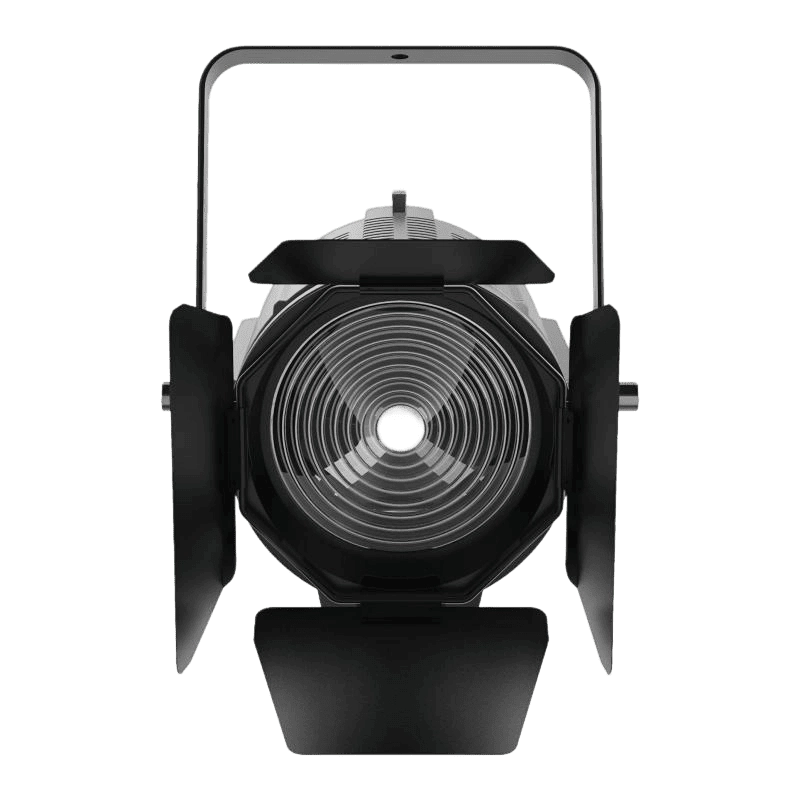
300 W RGBW LED Fresnel light
The LED Studio Fresnel Spotlight is a professional lighting device specifically designed for film and television studio stages, web series sets, and high-definition live streaming rooms. It features a high-power COB LED combined with a premium Fresnel lens optical system, delivering ultra-high color rendering (Ra ≥ 95, R9 ≥ 90, TLCI ≥ 96) and uniform and soft light output with smooth edge transitions. Free from harmful UV/IR radiation, it protects actors’ skin and props.
The spotlight offers 0–100% 16-bit linear flicker-free dimming and supports DMX512/RDM remote control. Coupled with four-leaf barndoors, it enables precise shaping of character outlines and scene layering.
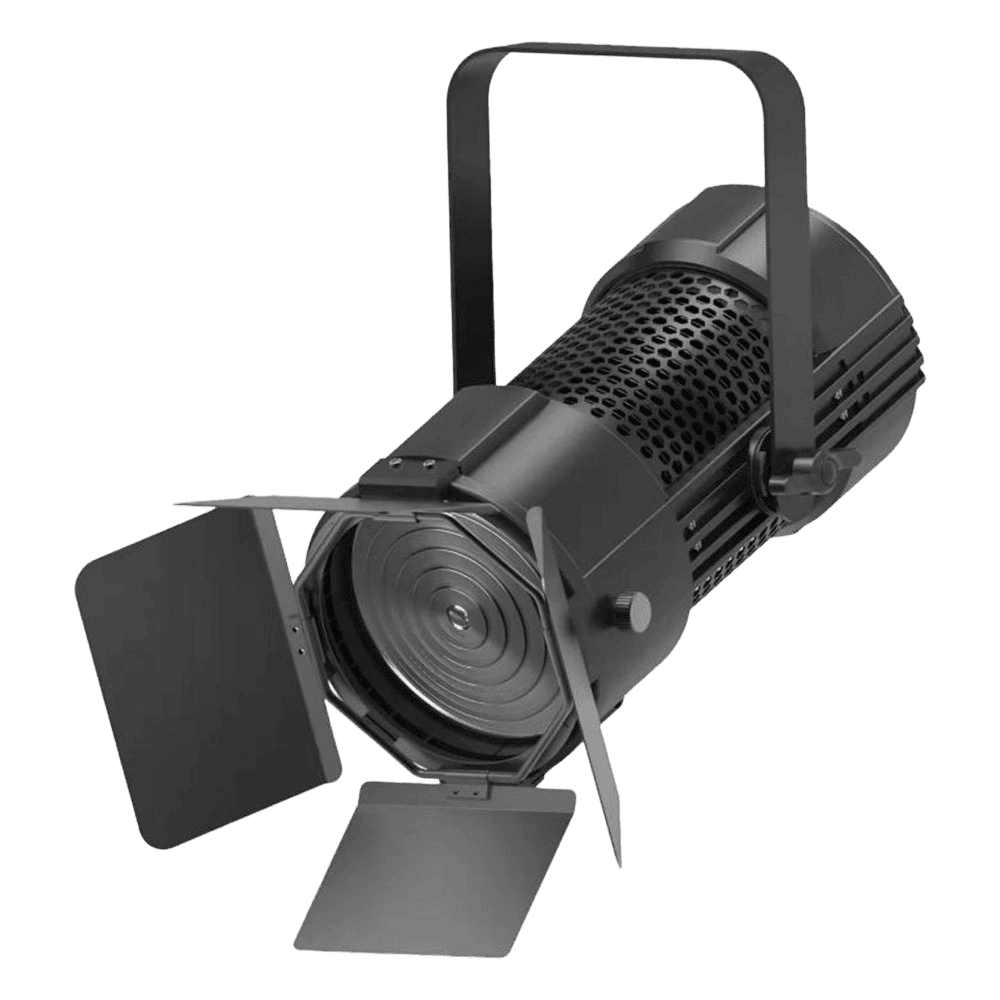
100W LED Fresnel Light
The LED Studio Fresnel Spotlight is a professional lighting device specifically designed for film and television studio stages, web series sets, and high-definition live streaming rooms. It features a high-power COB LED combined with a premium Fresnel lens optical system, delivering ultra-high color rendering (Ra ≥ 95, R9 ≥ 90, TLCI ≥ 96), uniform and soft light output with smooth edge transitions. Free from UV/IR harmful radiation, it protects actors’ skin and props. The spotlight offers 0–100% 16-bit linear flicker-free dimming and supports DMX512/RDM remote control. Coupled with four-leaf barn doors, it enables precise shaping of character outlines and scene layering.
Flexible color temperature options include 3200K (warm white tungsten), 5600K (cool white daylight), or continuously adjustable from 2700K to 6500K. With minimal color deviation (SDCM), it ensures true-to-life skin tone reproduction.
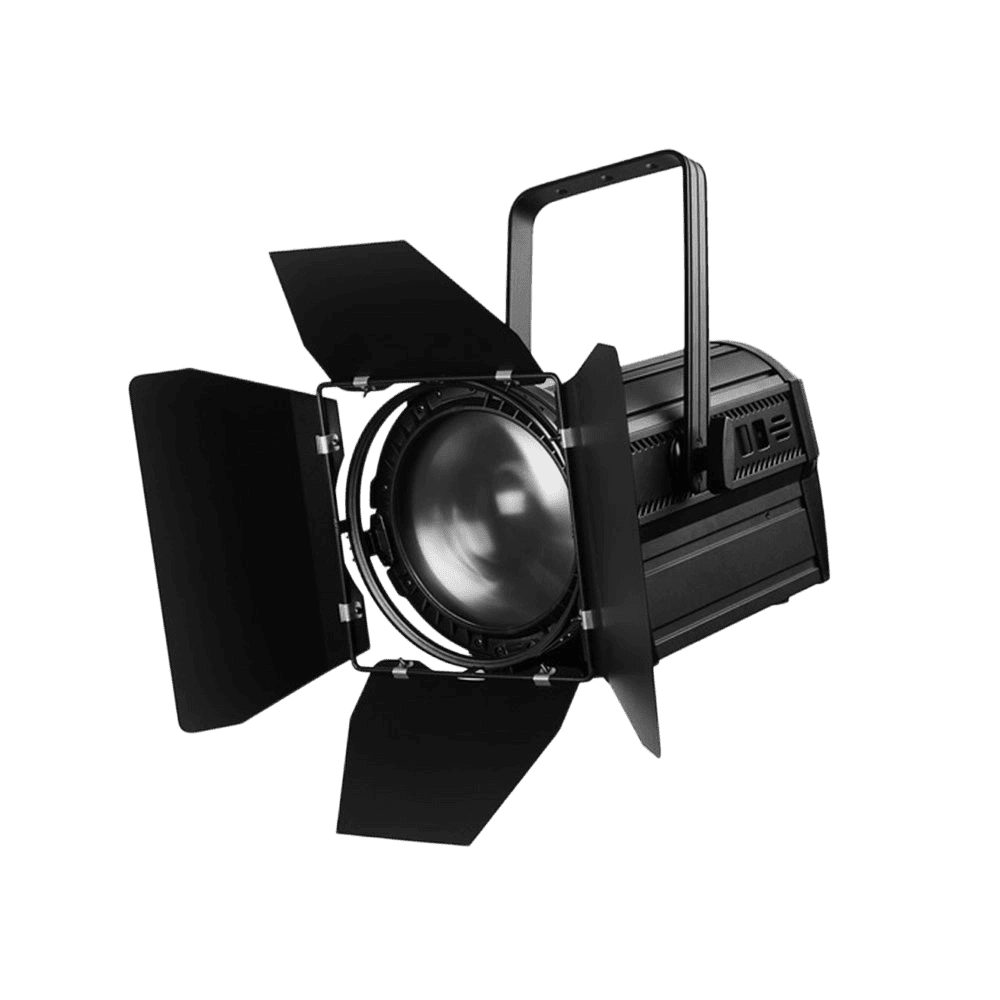
200 W RGBW LED Fresnel Light
The LED Studio Fresnel Spotlight is a professional lighting device specifically designed for film and television studio stages, web series sets, and high-definition live streaming rooms. It features a high-power COB LED combined with a premium Fresnel lens optical system, delivering ultra-high color rendering (Ra ≥ 95, R9 ≥ 90, TLCI ≥ 96) and uniform and soft light output with smooth edge transitions. Free from harmful UV/IR radiation, it protects actors’ skin and props.
The spotlight offers 0–100% 16-bit linear flicker-free dimming and supports DMX512/RDM remote control. Coupled with four-leaf barndoors, it enables precise shaping of character outlines and scene layering.
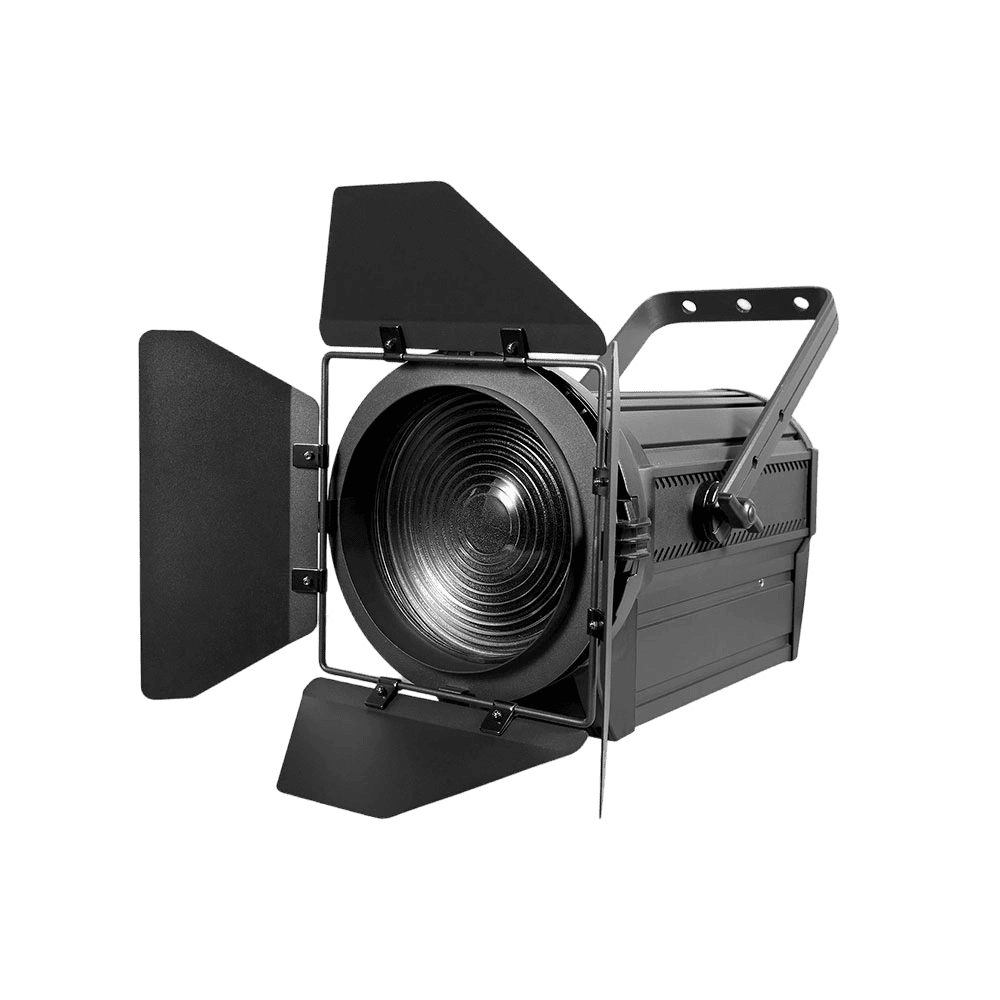
200W LED Fresnel Light
The LED Studio Fresnel Spotlight is a professional lighting device specifically designed for film and television studio stages, web series sets, and high-definition live streaming rooms. It features a high-power COB LED combined with a premium Fresnel lens optical system, delivering ultra-high color rendering (Ra ≥ 95, R9 ≥ 90, TLCI ≥ 96), uniform and soft light output with smooth edge transitions. Free from UV/IR harmful radiation, it protects actors’ skin and props.
The spotlight offers 0–100% 16-bit linear flicker-free dimming and supports DMX512/RDM remote control. Coupled with four-leaf barn doors, it enables precise shaping of character outlines and scene layering.
Discuss Your Lighting Project with Our Experts
If you have any comments or good suggestions, please leave us a message; later our professional staff will contact you as soon as possible.
Creating a superior lighting experience with pure light colors.
Guangzhou LEEMC Stage Lighting Technology Co., Ltd.
Email: info@lmstagelight.com
WhatsApp: +86 188 2626 7413
Address: Room 601, Unit 01, Building A8, Zone A, Konggang Meiwan Science and Technology Park, Huadu District, Guangzhou City, Guangdong Province, China.
Social media:
LM light
lmstage
LM STAGE